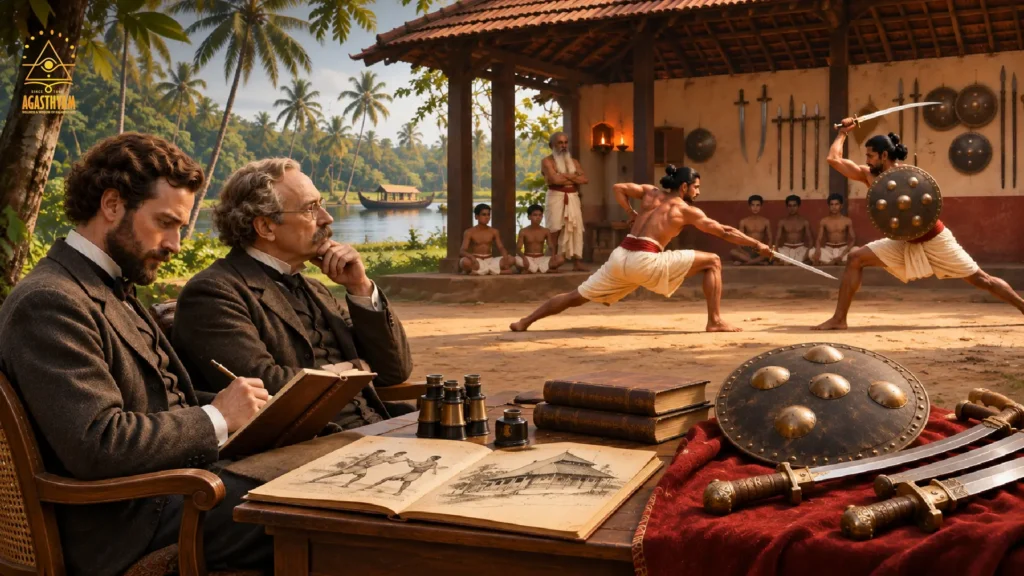
For more than five hundred years, visitors to the Malabar coast have stopped to watch Kerala’s warriors train. Persian envoys, Russian merchants, Portuguese chroniclers and British officers all left notes. Few came to study a martial art. Almost all of them ended up writing about one.
That art was Kalaripayattu, also known as Kalari Payattu: the training of the Kalari, Kerala’s traditional practice ground.
Their accounts matter because they are outside witnesses. They had no reason to flatter the tradition. Yet, century after century, they describe the same things: early training, astonishing flexibility, a wide range of weapons and a discipline that lasted a lifetime.
Here is what they saw, and what it tells us about how Kalaripayattu in Kerala survived.
The Fifteenth Century: Envoys and Merchants
Abd-al-Razzaq Samarqandi (1440s)
Afanasy Nikitin (1460s-1470s)
The Sixteenth Century: Portuguese and Italian Eyewitnesses
Duarte Barbosa: the clearest early picture
The Portuguese writer Duarte Barbosa reached Kerala in the early 1500s and left the most detailed early account of Kalari training.
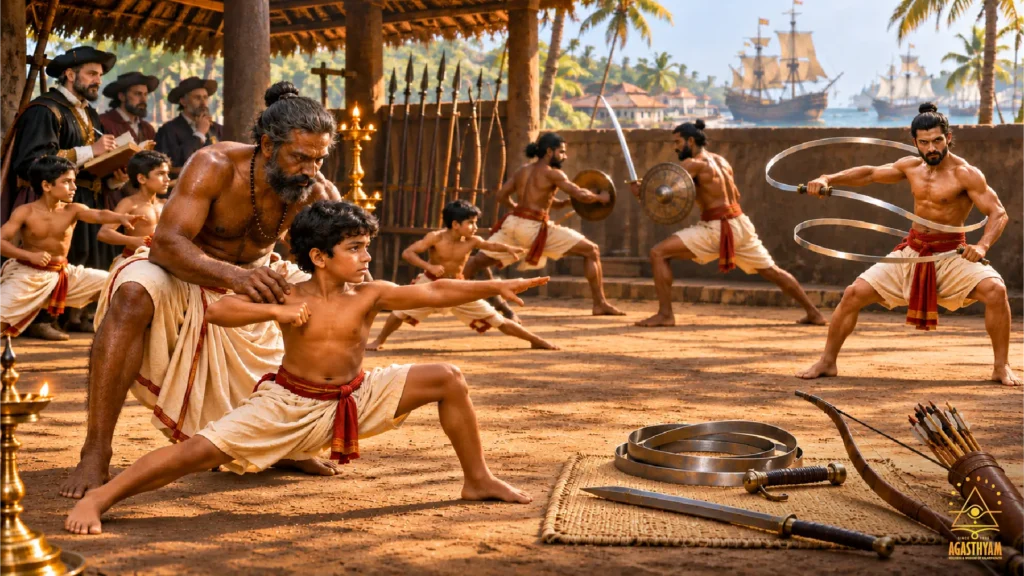
He wrote that boys began at about seven years old. Training started early in the day, and the aim of the first years was a supple, flexible body; he describes joints so loose the body could twist and turn with ease. Only then came weapons: bows and arrows, poles and spears, and above all the sword. And the practice never stopped. Warriors, he wrote, kept returning to their fencing lessons until the end of their lives.
Barbosa wrote about the training of the Nairs and of the Thiyya (Chekavar) communities. Together their Kalaris formed a network of martial culture across Malabar. It is the same structure of Kalaripayattu training that survives today: body first, weapons later, practice for life.
The period also gives us the urumi, the flexible sword that could be worn coiled at the waist like a belt and drawn in an instant.
Ludovico di Varthema
João de Barros and Fernão Lopes de Castanheda
Luís de Camões, Os Lusíadas (1572)
The Colonial Record: Surgeons, Collectors and Anthropologists
Francis Day, The Land of the Permauls (1863)
William Logan, Malabar (1887)
Fred Fawcett, Nayars of Malabar (1901)
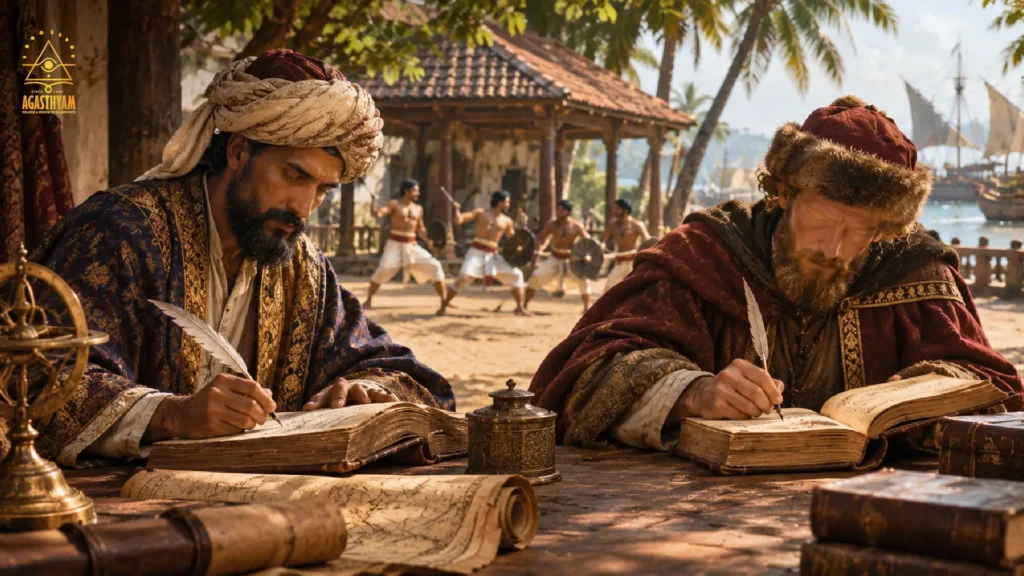
Fawcett, a retired police superintendent writing for the Madras Government Museum, gave one of the most vivid descriptions of Kerala martial arts at the turn of the century. He describes wooden shields covered in hide and studded with half-spheres that rang like a dancer’s anklets, and many kinds of swords. He also recorded a visit to a Kalari at Payyoli in 1895.
Fawcett’s view had limits. He focused on the Nairs and did not fully capture how many communities kept their own Kalaris.
Survival and Revival: What the Travellers Teach Us
Read together, these accounts span almost five centuries. Their writers came from Persia, Russia, Italy, Portugal and Britain. They agree on the essentials: training began in childhood, flexibility came before weapons, and the discipline lasted a lifetime.
That continuity was tested. Under British rule, the warrior role of the Kalari was suppressed and the carrying of arms restricted. Many Kalaris closed. The art survived in family lineages, where a Gurukkal quietly passed it to the next generation, and was revived in the twentieth century by teachers in north Kerala.
This is why lineage matters. The Kalari Gurukkal is the living link between what Barbosa saw in the 1500s and what a student learns today. Every Kalaripayattu Gurukkal carries knowledge that no book could fully record.
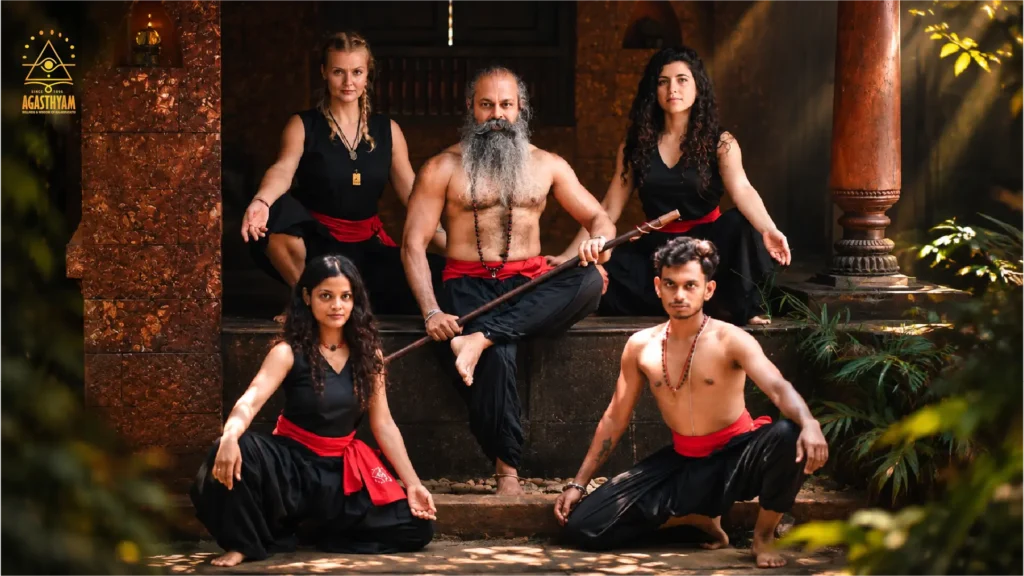
At Agasthyam, that line runs through five generations. It is the heart of Gurukkal Kalaripayattu, and of what Gurukkal S. Mahesh teaches as Warrior Monk Kalaripayattu: a living tradition, not a museum piece. It also shapes Warrior Yoga, his practice that carries the Kalari’s discipline of body, breath and stillness to people who may never pick up a sword.
Train Where History Was Written
The travellers could only watch. You can step inside the Kalari.
At Agasthyam Kalari in Nemom, Thiruvananthapuram, Gurukkal S Mahesh offers Kalaripayattu training in Kerala in the same order Barbosa described five centuries ago: body first, then movement, then weapons. If you want to learn Kalaripayattu properly, these are the ways in.
- Regular classes: Ongoing Kalaripayattu classes in Trivandrum, from foundations to advanced weapons.
- Residential training: Live and train at the Kalari. Our Kalari residential training in Kerala is the closest you can come to the old way of learning.
- Retreats: A Kalaripayattu and yoga retreat in India, pairing Kalari practice with Warrior Yoga and meditation.
- Online: Kalaripayattu online classes to build your foundations wherever you are.
- Teacher training: Kalaripayattu teachers training for those ready to carry the lineage forward, including Shakthi TTC, Advanced TTC and Treatment TTC.
The warriors of Malabar trained for life. So can you.