By Gurukkal S. Mahesh, fifth-generation Kalaripayattu Gurukkal and founder of Agasthyam Foundation
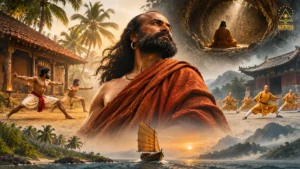
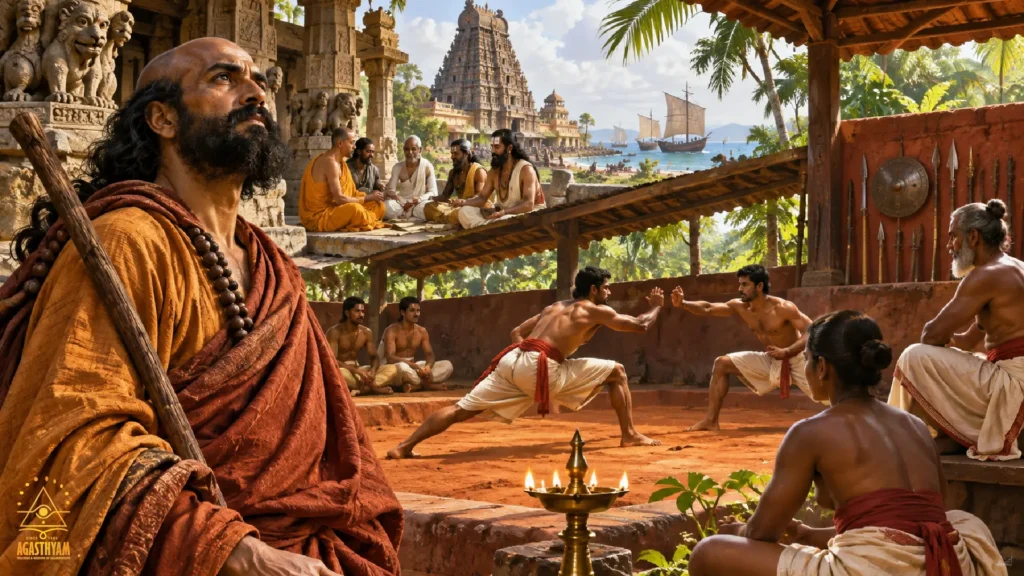
Picture a young monk on the shores of ancient South India. Behind him lies a civilisation rich in philosophy, medicine and martial discipline. Ahead lies the open sea. He carries no army and no ambition for a throne. His strength is his discipline, and his search for a deeper truth.
His name is Bodhidharma.
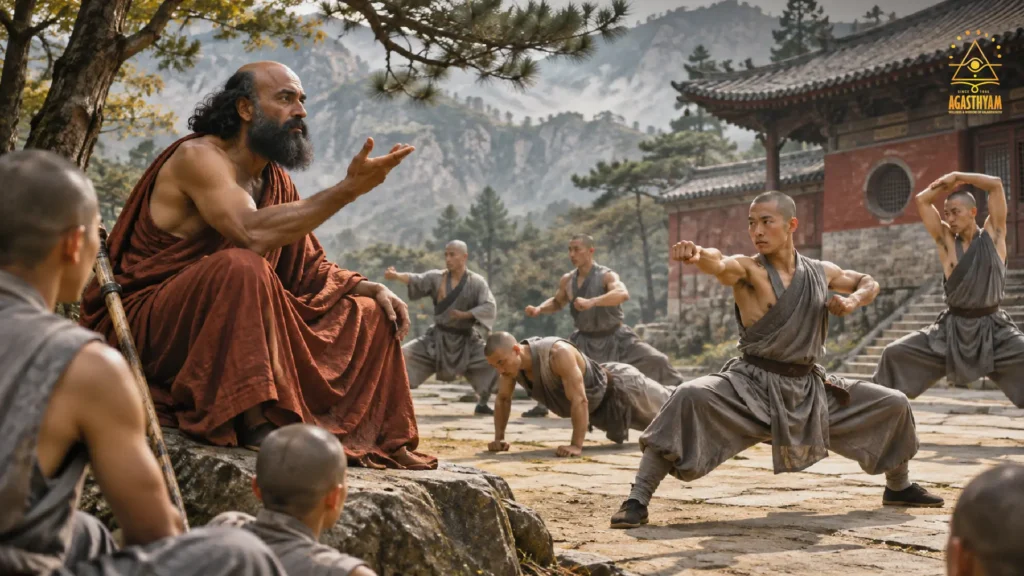
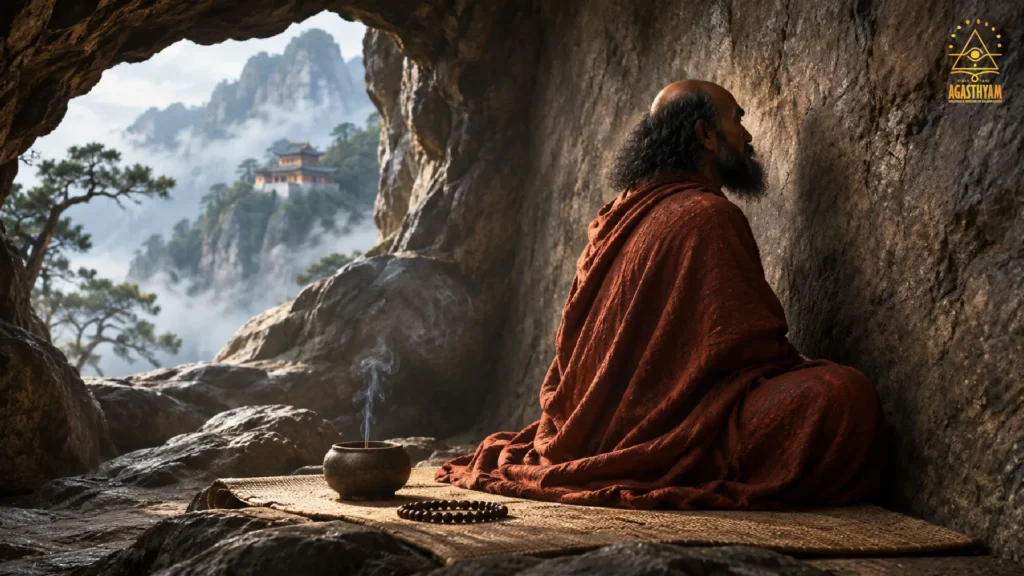
Now picture another scene, years later, in the mountains of China. In a cave near the Shaolin Monastery, a monk sits facing a wall. Seasons turn outside. He does not move. Tradition says he stayed this way for nine years.
The monk who crossed the seas and the master in the cave have become one legend. In China he is remembered as Damo. In the history of Buddhism, he is honoured as a founding figure of Chan, the tradition that later shaped Zen in Japan.
For me, as a Kalari Gurukkal from Kerala, his story opens another window. Whenever I trace his link to Shaolin, I find myself looking back at the martial and spiritual landscape of South India, the home of Kalaripayattu (also written Kalarippayattu).
What physical knowledge existed in the land he left? How were martial arts, medicine, breath and spiritual practice connected? And why do the movements of Kalaripayattu echo so strikingly in the martial traditions of China?
This is not about claiming that one civilisation invented the martial arts of another. It is about exploring shared principles and cultural exchange between two great Asian traditions. That is the spirit in which I teach Warrior Monk Kalaripayattu today.
The Land of Warriors and Sages: Kerala Martial Arts and the Pallava World
Tradition places Bodhidharma in South India, often as a prince of the Pallava court at Kanchipuram, sometimes as the third son of a royal family. Historians still debate his birthplace, ancestry and early life.
Kanchipuram is still a compelling setting. Under the Pallavas, it was a centre of religious, philosophical and artistic life. Buddhist, Jain and Hindu traditions flourished side by side. Sea routes linked the southern coast to Sri Lanka and Southeast Asia.
This was a world where knowledge was not split into neat boxes. Philosophy, medicine, physical discipline and spiritual practice grew together. South India’s martial heritage keeps that integrated approach alive.
Adimurai and Varma Kalai reflect a sophisticated understanding of the human body. Kalaripayattu, preserved most fully in Kerala, offers a complete system of body conditioning, movement, postures, weapons and discipline. Kalari Payattu, as it is also called, sits at the heart of the Kerala martial arts.
I grew up inside this tradition. The Kalari was never just a place to learn to fight. It was where you came to understand the body and train the mind, and to learn respect, control and the responsibility that martial knowledge carries.
We cannot say that Bodhidharma personally studied Kalaripayattu or Adimurai in their present forms. The evidence does not allow it. But the martial traditions of South India give us a meaningful lens through which to read his journey.
Across the Seas: Bodhidharma Reaches China
The traditional story brings Bodhidharma to China in the fifth or sixth century CE.
His meeting with Emperor Wu of the Liang dynasty is the most famous episode. The emperor was a generous patron of Buddhism, building monasteries and supporting monks. He asked Bodhidharma how much merit he had earned. The monk’s answer was blunt: outward deeds are not the same as inner understanding.
That exchange captures the heart of Chan. Realisation comes through direct experience and inner change, not through recognition.
Bodhidharma’s name then becomes tied to the Shaolin Monastery near Mount Song, and to the practice of meditating while facing a wall.
Another story grows around him. According to Shaolin tradition, he found monks whose bodies had grown weak from long hours of sitting meditation. He is said to have taught them exercises to build strength and endurance for the demands of spiritual life. Over time, these accounts became linked to the legendary origins of Shaolin training.
It is important to be clear: China had wrestling, boxing and military combat long before Bodhidharma. Still, the story raises a fair question. Could the wider exchange between India and China have shaped ideas about physical discipline, meditation and inner cultivation?
This is where comparing Kalaripayattu with Shaolin becomes meaningful.
The Body as the Foundation: Meythozhil and the Yi Jin Jing
Two texts are often linked to Bodhidharma and Shaolin: the Yi Jin Jing, or Classic of Sinew Transformation, and the Xi Sui Jing, or Classic of Marrow Washing. The first is about strengthening muscles, tendons and structure. The second is about deeper internal cultivation.
Popular Shaolin narratives credit both to Bodhidharma. But the surviving texts date from long after his lifetime, so that attribution cannot be treated as historical fact.
What interests me is the philosophy behind them. In Kalaripayattu training, a student never begins with advanced combat. The body is prepared first.
- Meythozhil builds physical conditioning.
- Chuvadu teaches stepping and movement patterns.
- Vadivu introduces the characteristic postures.
Step by step, the student learns to move the whole body as one. The body is not an obstacle to spiritual growth. It is an instrument to be cultivated. Shaolin training rests on the same idea, even if its methods and explanations differ.
A strong body alone does not make a complete martial artist. Strength must be matched by awareness, restraint and discipline.
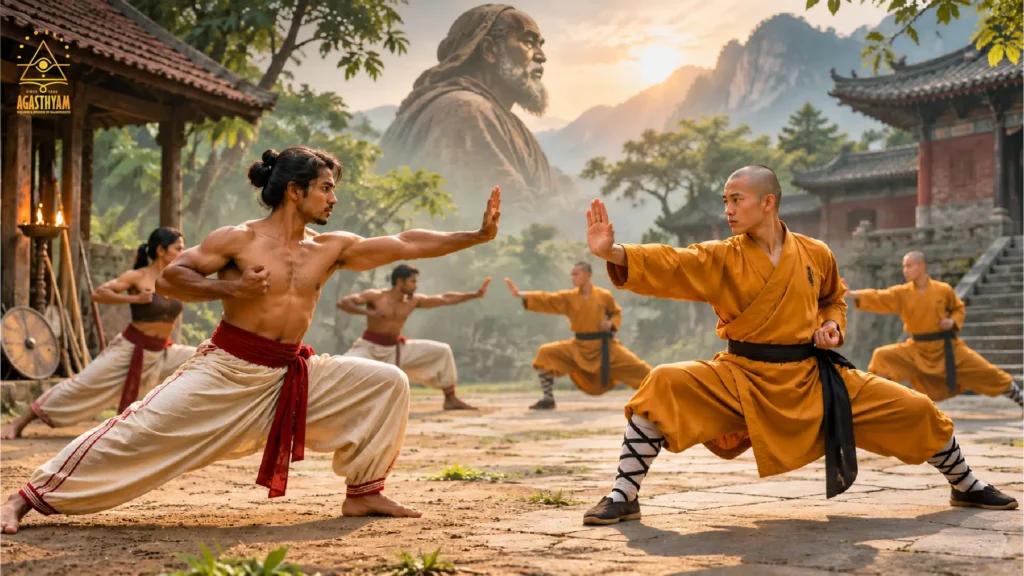
Ashta Vadivu and the Animal Styles of Shaolin
One of the most striking links between the two traditions is the use of animal movement.
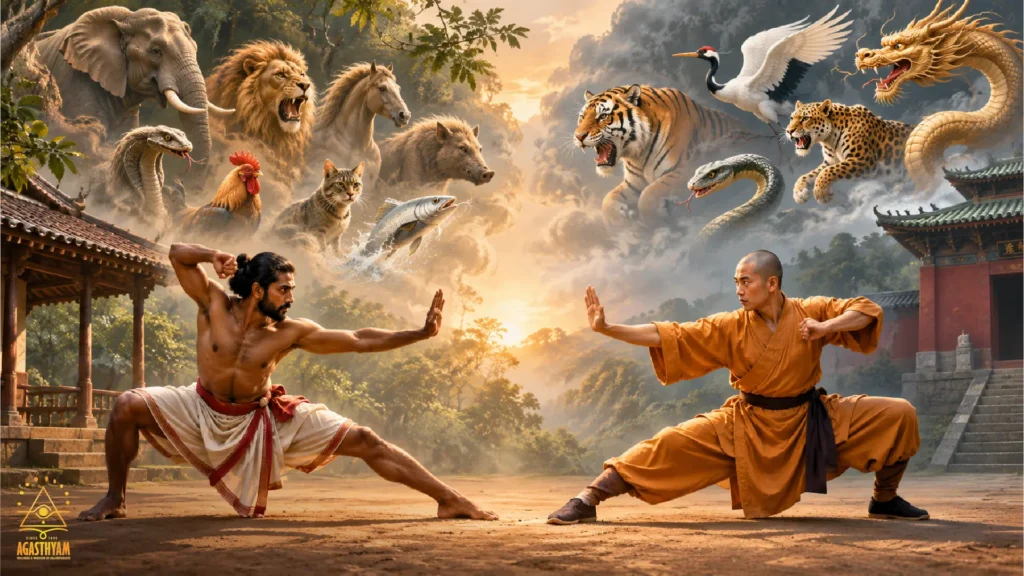
In Kalari training we practise the Ashta Vadivu, eight animal-inspired postures:
- Gaja Vadivu – Elephant
- Simha Vadivu – Lion
- Ashwa Vadivu – Horse
- Varaha Vadivu – Wild Boar
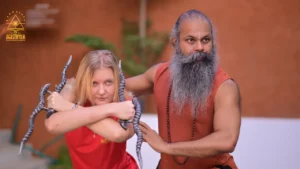
- Sarpa Vadivu – Snake
- Kukkuda Vadivu – Cock
- Marjara Vadivu – Cat
- Matsya Vadivu – Fish
The elephant brings grounded strength. The lion, courage and power. The horse, mobility. The snake, fluidity. The cat, alertness and precise response. When I teach Ashta Vadivu, I ask students to understand the movement, not just copy the shape.
Chinese martial arts built their own animal vocabulary. The tiger stands for power, the crane for balance and precision, the leopard for explosive speed, the snake for adaptability, and the dragon for integrated, flowing movement.
The forms are not identical, and their histories should not be blurred. But both traditions look to nature as a teacher, and both know that effective movement needs more than muscle. Balance, timing, flexibility and awareness matter as much.
The animal becomes the teacher.
Adavu and Taolu: The Language of Movement
In Kalaripayattu, an Adavu is a trained technique. Payattu sequences link these into patterns of attack, defence and movement. In some lineages, eighteen Adavus form the backbone of training. Through repetition, a learned movement becomes an instinctive response.
Chinese martial arts preserve knowledge through Taolu, the organised sequences known as forms. A Taolu may include stances, strikes, blocks, turns and weapon work.
Then there are the Eighteen Lohan Hands, or Eighteen Arhat Hands, linked in Shaolin tradition to Bodhidharma. Eighteen Adavus in South India, eighteen Lohan Hands in China: an intriguing numerical parallel. There is, however, no established evidence that one came from the other.
What matters more is the principle. In both, knowledge passes through disciplined repetition. The goal is never to perform beautifully for an audience. It is to build a body that understands movement, timing and response.
Chuvadu, Vadivu and the Chinese Stances
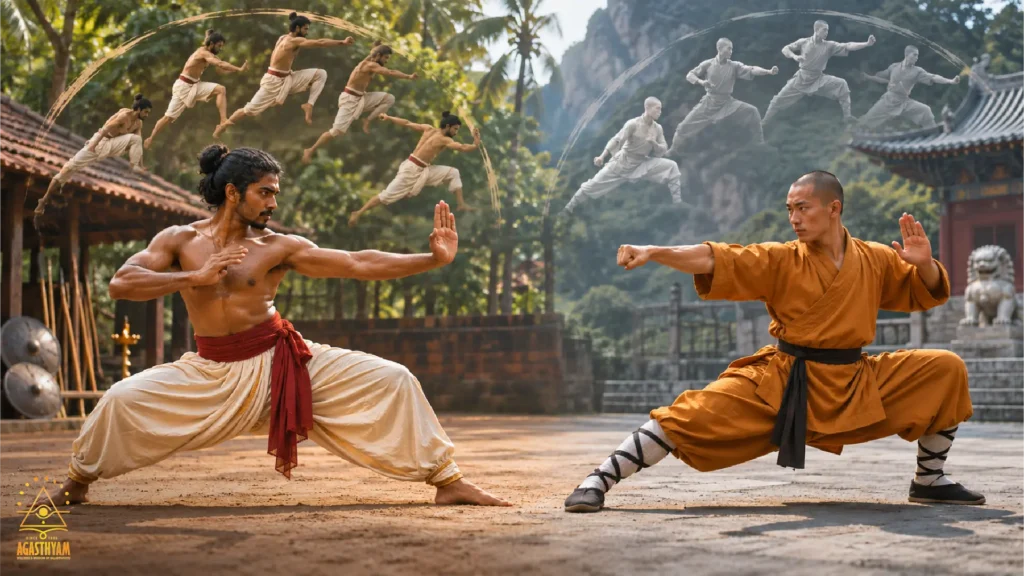
Chuvadu (footwork) and Vadivu (posture) give a Kalaripayattu student stability, balance and control. You learn to shift weight, change direction and connect legs, waist and upper body.
Chinese martial arts place the same weight on stances: the horse stance, bow stance, cat stance and others. When I watch an experienced Shaolin practitioner, I recognise the principles we stress in the Kalari.
Power does not start in the arms. It rises from the ground, through the legs and waist, and is released by the whole body. The methods differ. The understanding of body mechanics is shared.
Weapons: The Extended Body of the Warrior
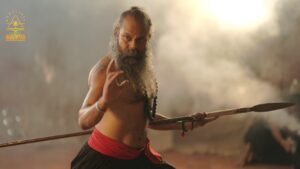
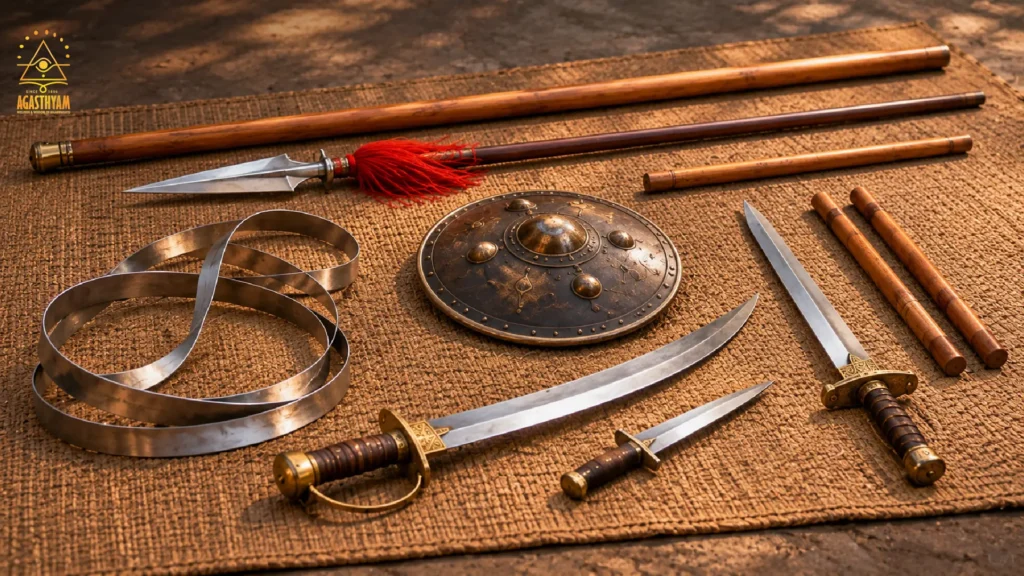
Kalaripayattu preserves a remarkable range of weapons: the long staff, short stick, sword and shield, dagger, spear and the Urumi, a flexible sword that demands exceptional control and awareness.
Shaolin and other Chinese systems keep their own arsenal: staff, spear, straight sword, broadsword and more. The staff is central to both. It trains coordination, distance, rotation and the link between footwork and upper body. The spear demands precision and timing in both cultures too.
In traditional training, a weapon is never simply held. It becomes part of the body. That is why weapons training takes years, and why it must be used responsibly.
Varma, Marma and the Chinese Knowledge of Vital Points
Perhaps the most distinctive link between the two traditions is their study of the body’s vital regions.
In Adimurai and Varma Kalai, knowledge of Varma holds a special place, in both combat and healing. In Kerala, the knowledge of Marmam is closely tied to Kalaripayattu and its therapeutic heritage, and to the Siddha tradition.
Chinese martial culture has Dian Xue, the striking or pressing of vital points, alongside a medical tradition of meridians and acupoints. The parallels are real, though the anatomy, terminology and philosophy behind each system differ.
What this reminds us is simple. Traditional martial knowledge was never only about attack and defence. The same body trained for combat must also be protected, maintained and healed. Anyone who holds this knowledge carries a responsibility with it.
Prana and Qi: Breath, Energy and Inner Cultivation
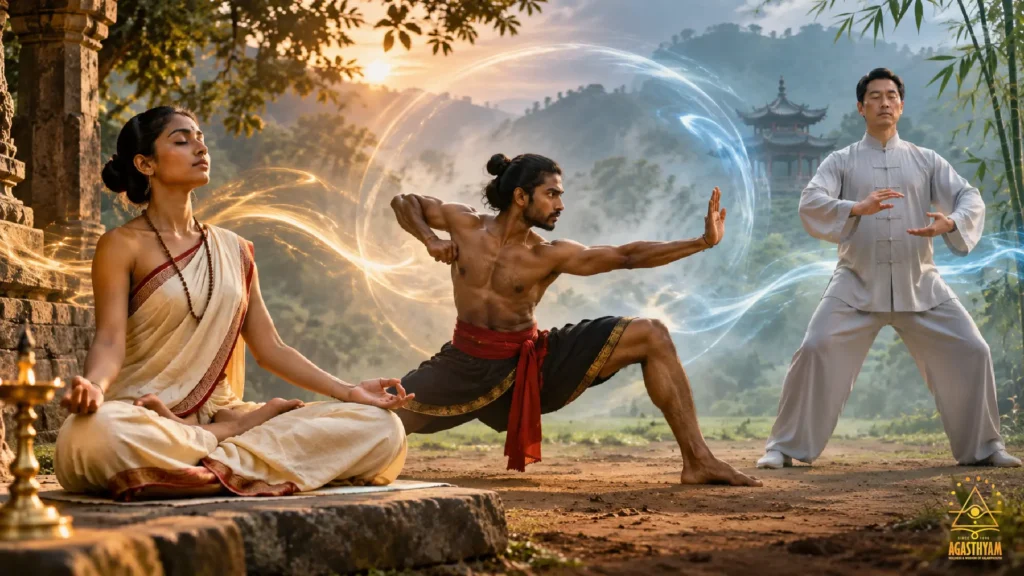
Indian traditions explore breath, vitality and consciousness through Prana. Yoga and Pranayama train awareness of the breath and a steady mind. Chinese traditions speak of Qi, and Qigong combines posture, breathing, movement and concentration.
Prana and Qi are not interchangeable scientific terms. They come from distinct philosophical systems. But both shaped how practitioners understood breath and the cultivation of the body.
In Kalaripayattu, breath is woven into every sequence. A student learns to coordinate breathing with movement and stay in control under strain.
Both traditions agree that martial training cannot stay purely external. A practitioner who has strength but cannot control impulse or hold concentration has missed the deeper purpose.
Where Martial Arts Meet Healing
In Kerala, the Kalari has always gone hand in hand with healing: Kalari Uzhichil (therapeutic massage), knowledge of Marmam, and the wider medical traditions of Siddha and Ayurveda. The point is not just exercise followed by massage. The body must be cared for throughout training.
Shaolin culture, too, is remembered for health practices, therapeutic massage and herbal knowledge alongside its martial techniques.
The two medical systems are distinct and should be understood on their own terms. But their shared bond with martial training is rich ground for exchange between South Indian and Chinese practitioners, especially in movement, conditioning and recovery.
The Gurukkal and the Shaolin Master
In the South Indian Gurukulam tradition, the Gurukkal, or Ashan, sits at the centre of learning. A student does not learn from instructions or a single demonstration. They learn through observation, repetition, correction and years of personal guidance. The Kalaripayattu Gurukkal watches each student grow and opens the next door only when they are ready.
Shaolin built its own institution for passing on Buddhist teaching and martial practice across generations of monks and masters. A Gurukulam and a monastery are different worlds. Yet both rest on the teacher, disciplined practice and continuity.
A martial art survives only because someone takes responsibility for passing it on. What I received from my own Gurukkal was never just a set of movements. It was a responsibility. That is the heart of Gurukkal Kalaripayattu: a lineage carried by a person, not a syllabus.
Bodhidharma and the Nine Years of Silence
Let us return to the cave.
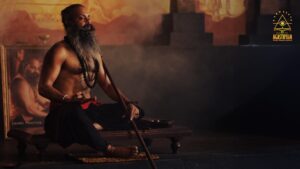
The monk facing the wall for nine years is one of the most powerful images in Asian spiritual history. To me, it matters as much as any Shaolin legend.
In the Kalari, movement is essential, but so is stillness. A practitioner must learn when not to move. Patience, observation and control are core skills. The warrior who cannot control his mind cannot fully control his actions.
This is the thinking behind Warrior Yoga, the practice I teach as a journey from strength to stillness. It draws on the same South Indian roots of physical discipline, breath and meditation that the Shaolin tradition honours in its own way.
Perhaps this is the deepest meaning of the warrior monk. Not a fighter who adopted a spiritual identity, but someone who knows the greatest challenge is mastery of oneself.
A Legacy Beyond Borders
For centuries, monks, scholars, merchants and travellers moved between India, China and Southeast Asia. Sea routes from the southern Indian coast carried ideas, art and knowledge. Bodhidharma’s journey belongs to that history.
Whether or not the later stories of his role in Shaolin training can be proven, his link to the monastery has become a powerful symbol of the bond between Indian spiritual traditions and Chinese martial culture.
China already had sophisticated martial traditions. Shaolin Kung Fu grew from centuries of Chinese experience and many generations of practitioners. South Indian martial arts have their own histories and lineages too. Each deserves respect on its own terms.
That does not stop us from studying them side by side.
| South Indian Tradition | Chinese Tradition |
|---|---|
| Ashta Vadivu – eight animal postures | Shaolin animal styles – tiger, crane, leopard, snake, dragon |
| 18 Adavus | Eighteen Lohan Hands |
| Adavu and Payattu sequences | Taolu (martial forms) |
| Chuvadu and Vadivu | Chinese stances and footwork |
| Kalari and Silambam weapons | Shaolin staff, spear and sword |
| Varma Kalai and Marmam | Dian Xue and vital-point traditions |
| Pranayama and Prana | Qigong and Qi |
| Siddha and Kalari healing | Traditional Chinese medicine and Shaolin healing |
| Gurukkal and Gurukulam | Shaolin masters and monastery training |
When I watch a Shaolin monk perform, I see years of discipline and repetition. When I stand in a Kalari in Kerala and watch a young student practise Vadivu or learn Chuvadu, I see the same commitment. The outward forms differ. The dedication is the same.
Perhaps Bodhidharma did not carry a complete martial system to China. Perhaps later Shaolin monks built their own methods from Buddhist discipline and Chinese martial practice. Those questions remain open. But his story reminds us that knowledge has never been confined by borders.
Begin Your Own Warrior's Journey: Kalaripayattu Training in Kerala
Bodhidharma’s story is still being lived in the Kalari. If it has stirred something in you, the best way to understand it is to train.
At Agasthyam Kalari in Nemom, Thiruvananthapuram, I offer Kalaripayattu training in Kerala as a complete path: body, breath, weapons, healing and mind. Whether you want to learn Kalaripayattu for fitness, self-defence or self-discovery, there is a way in.
- Kalaripayattu classes in Trivandrum: Regular Kalari training at our Kalari for every level, from first steps to advanced weapons.
- Kalari residential training in Kerala: Our residential Kalaripayattu programme lets you live and train inside the tradition, the way students always have. It is the most immersive way to experience Kalaripayattu in Kerala.
- Kalaripayattu and yoga retreat in India: Combine Kalari practice with Warrior Yoga and meditation in a residential Kalaripayattu retreat.
- Kalaripayattu online classes: Can’t travel yet? Learn Kalaripayattu online with guided sessions that build your foundation from home.
- Kalaripayattu teachers training (TTC): Certified programmes for those ready to teach, including Shakthi TTC, Advanced TTC and Treatment TTC.
Many students who come to us have tried other martial arts classes. What they find in the Kalari is something different: a living lineage, taught by a Gurukkal, with healing and discipline built in.
Frequently Asked Questions
Did Bodhidharma teach Kalaripayattu at Shaolin?
Is Kalari good for beginners in Kerala?
Can foreigners learn Kalaripayattu?
Where can I find the best Kalaripayattu training in Kerala?
What are Kalaripayattu training fees in Kerala?
I can't find Kalaripayattu classes near me. What are my options?
Who is Gurukkal S Mahesh?
About the Author
Gurukkal S. Mahesh is a fifth-generation Kalaripayattu Gurukkal, known as the Warrior Monk. He is the founder of Agasthyam Foundation and Principal Investigator of the IKS Centre for Kalarippayattu and Siddhar Tradition, Ministry of Education, Government of India.
A lifelong practitioner and teacher of Kalaripayattu, Yoga, Meditation and the Siddhar Tradition, he is also an author and filmmaker. He has led specialised martial arts and self-defence training for the Indian Army, the CRPF and police forces, bringing traditional Indian martial knowledge into modern training.
The body is trained to become strong. The mind is disciplined to become steady. The warrior’s greatest victory is mastery of himself.