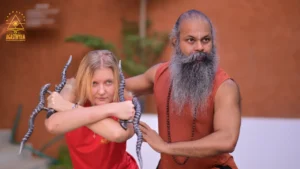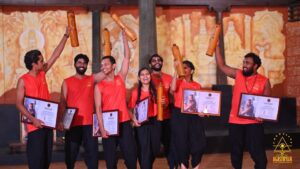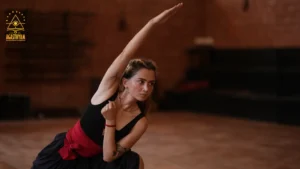
Why would a martial artist from Europe, America, Russia, Japan or Australia fly thousands of kilometres for Kalaripayattu training in Kerala?
It begins with a search.
A search for something a video can’t fully teach. For a martial tradition in its original environment. For the knowledge behind the movement. For India.
And for a growing number of international students who want to learn Kalaripayattu in India, that search leads to Agasthyam Kalaripayattu in Nemom, Thiruvananthapuram (Trivandrum), South India.
Why Kerala Is the Home of Kalaripayattu
India holds some of the world’s oldest martial traditions. Among them is Kalaripayattu, the traditional martial art of Kerala, rooted deep in the region’s history and culture.
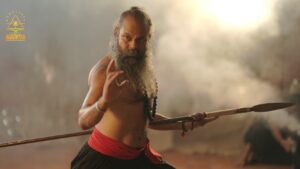
For most international practitioners, it starts with curiosity. The low stances. The extraordinary flexibility. The sword and shield. The long staff. The flowing, curved movement. The discipline of the Kalari.
Then comes the real question: where can I learn it authentically?
It matters, because Kalaripayattu isn’t a set of techniques you can lift out of the culture that made it. To understand it, students want the Kalari, the Guru, the environment and the daily discipline together. That’s why they come to Kerala.
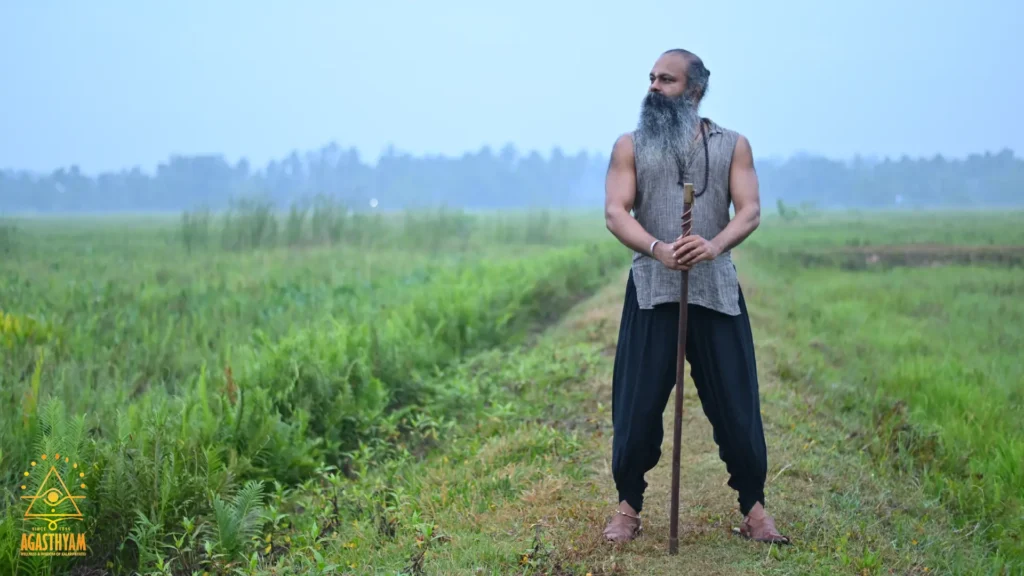
From Shaolin to Agasthyam: Training at the Source
Martial artists have always travelled to learn an art where it was born. They go to China for Shaolin. To Japan for its martial traditions. And increasingly, to Kerala for Kalaripayattu.
This isn’t about which tradition is older or better. It’s about a truth every serious practitioner knows:
The place matters. The teacher matters. The lineage matters. The way the art is lived matters.
Travelling to Kerala turns Kalaripayattu from something watched on a screen into something learned through the body.
Why Agasthyam: A Living Kalari in Trivandrum
Agasthyam isn’t a place to drop in for a Kalaripayattu class. It’s a living martial tradition with a structured environment for learning.
Its lineage traces back to the late nineteenth century, carried through generations of Gurukkals. Today, Gurukkal S. Mahesh represents the fifth generation.
That continuity is the point. Students don’t just learn movements. They enter a Kalari that is still part of an unbroken tradition.
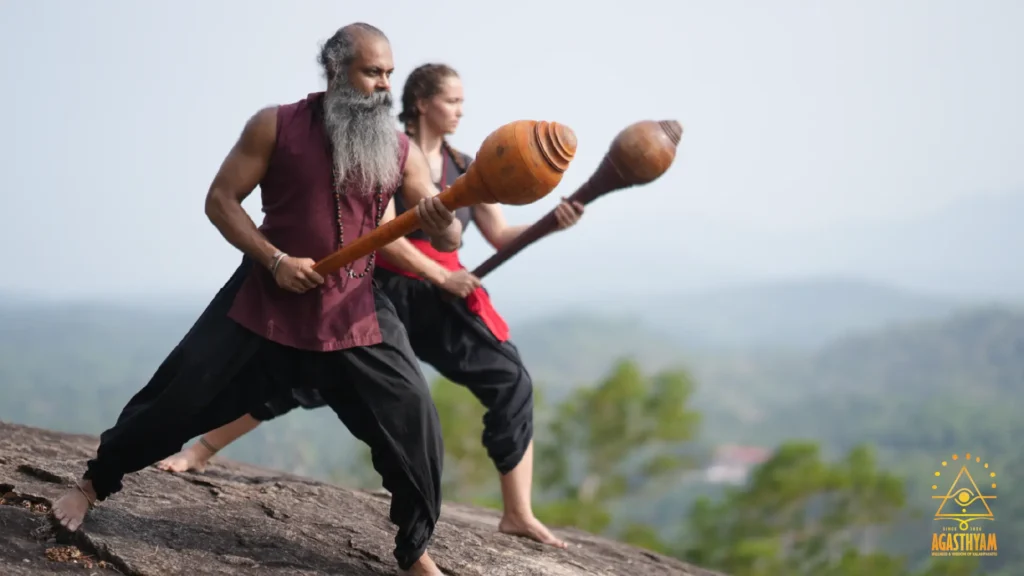
A Living Tradition, Not a Demonstration
The first question most international students ask: is this a performance for visitors, or a tradition still genuinely practised?
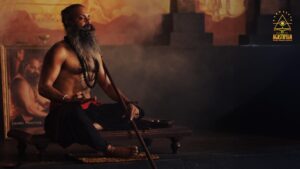
At Agasthyam, the Kalari sits within the home of the Gurukkal and his lineage. Residential students stay in a traditional family environment, not a resort built for tourists.
You wake inside the training environment. Walk to the Kalari. Practise. Eat. Rest. Study. Practise again.
A short tourist experience can’t give you that. Continuity can.
Meet the Gurukkal: A Fifth-Generation Kalaripayattu Lineage
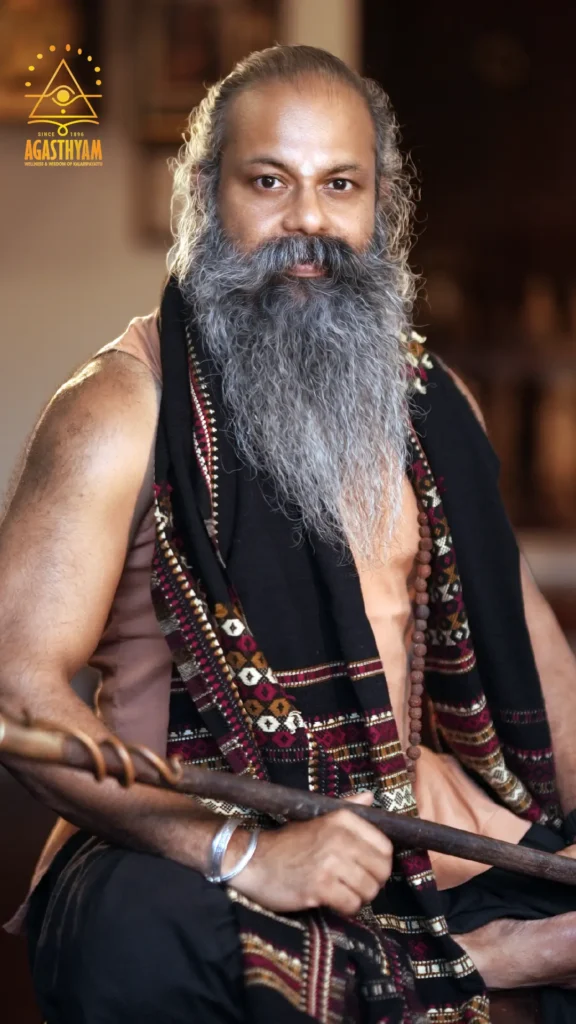
In Kalaripayattu, the Gurukkal is more than an instructor. Students learn through observation, correction, repetition and proximity.
Gurukkal S. Mahesh is a fifth-generation practitioner and teacher whose work has carried Kalaripayattu into educational, institutional and international settings. He is a lifelong practitioner and teacher of Kalaripayattu, Yoga, Meditation and the Siddhar tradition, with programmes spanning Indian Knowledge Systems, martial arts education, traditional wellness and the preservation of the art.
For international students, that means learning from a teacher rooted in lineage and fluent in the modern academic world.
Traditional Knowledge, Taught Systematically
Agasthyam brings traditional values and structured learning together. Serious students arrive asking more than how do I do this movement? They ask:
- Why is it performed this way?
- What principle sits behind it?
- How does breath support the practice?
- How does Kalari training relate to yoga and wellness?
- How were weapons traditionally approached?
- How is an ancient art passed on responsibly to a new generation?
This is why Agasthyam positions itself as an Excellence Centre for Kalaripayattu and Indian Knowledge Systems: structured training, inside the knowledge environment the art came from.
More Than a Kalari: The Home of Warrior Yoga
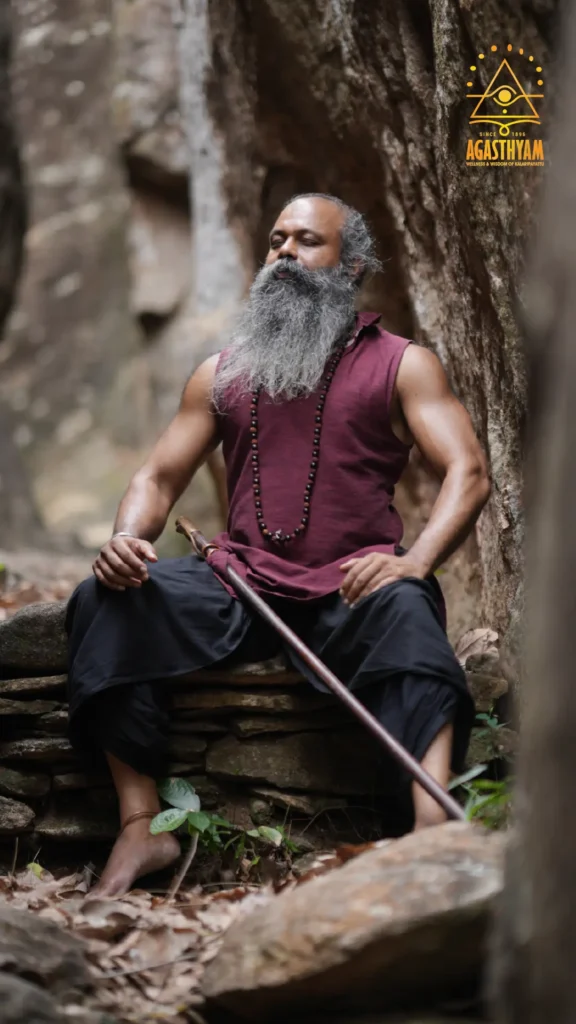
At the heart of Agasthyam is an idea developed through Gurukkal S. Mahesh’s work: the Kalari as a space for Warrior Yoga.
The warrior and the yogi seem to live in different worlds. But Indian traditions have long explored how body, breath, concentration, discipline and consciousness connect.
So at Agasthyam, Kalaripayattu training sits within a wider ecosystem:
- Kalaripayattu
- Warrior Yoga
- Breath and movement practice
- Meditation
- Traditional wellness and Ayurveda-based therapies
- The Siddhar tradition
- Indian Knowledge Systems
The goal isn’t to turn Kalaripayattu into a fitness programme. It’s to explore how martial practice, physical discipline and inner development belong together. Strength outside. Stillness inside.
Kalari, Yoga and Ayurveda Wellness Under One Roof
For international students, the experience goes beyond martial training. Three disciplines work together:
- Kalari — the warrior’s physical discipline: strength, agility, flexibility, weapons and martial awareness.
- Yoga — breath, concentration, balance and inner awareness.
- Traditional wellness — recovery and body care, including Ayurveda-related therapies.
It’s an ecosystem, not a single class. You train hard, and you learn how to recover, restore and maintain the body that does the training.
The Residential Kalaripayattu Programme: Live the Discipline
The biggest reason international students choose residential training is continuity.
A regular class lasts an hour or two, then you return to ordinary life. At Agasthyam, residential students stay inside the training environment. A typical day:
See full details (link back to residential page)
That rhythm builds what occasional classes rarely can: consistency.
A Safe, Structured Training Environment
When you’re travelling from another country, the setting matters as much as the training. Students want to know where they’ll stay, what they’ll eat, how much they’ll train, who will guide them and how recovery is handled.
Agasthyam’s residential model covers it: accommodation, meals, a structured daily routine, supervised training and progressive practice. You focus on learning. The logistics are taken care of.
Food Is Part of the Training
Training the body without nourishing it is incomplete. Meals and recovery are built into the residential day.
For international students, food becomes part of the cultural experience too. Kerala has its own ingredients, food traditions and relationship with wellbeing. Over several weeks, every meal is another way of living Kerala, not something squeezed between classes.
What International Students Learn at Agasthyam
Most arrive for Kalaripayattu. Most leave with much more. Students learn how to:
- Enter the Kalari and prepare the body
- Move with control
- Coordinate breath and movement
- Build flexibility, and strength without losing mobility
- Repeat a movement until it becomes natural
- Listen to correction
- Respect the training space
- Live with discipline
And above all, how a martial tradition is lived, not merely performed.
From Beginner to Serious Practitioner
You don’t need to arrive as an expert. Kalaripayattu at Agasthyam is open to beginners and experienced martial artists alike, with training structured progressively by experience and programme.
For some, the journey starts with body conditioning and foundational movements. For others, it’s a deeper immersion into traditional practice.
The principle is progression. The body is never asked to do what it hasn’t been prepared for.
Foundation first. Technique next. Depth through repetition.
Why Travel All the Way to Kerala?
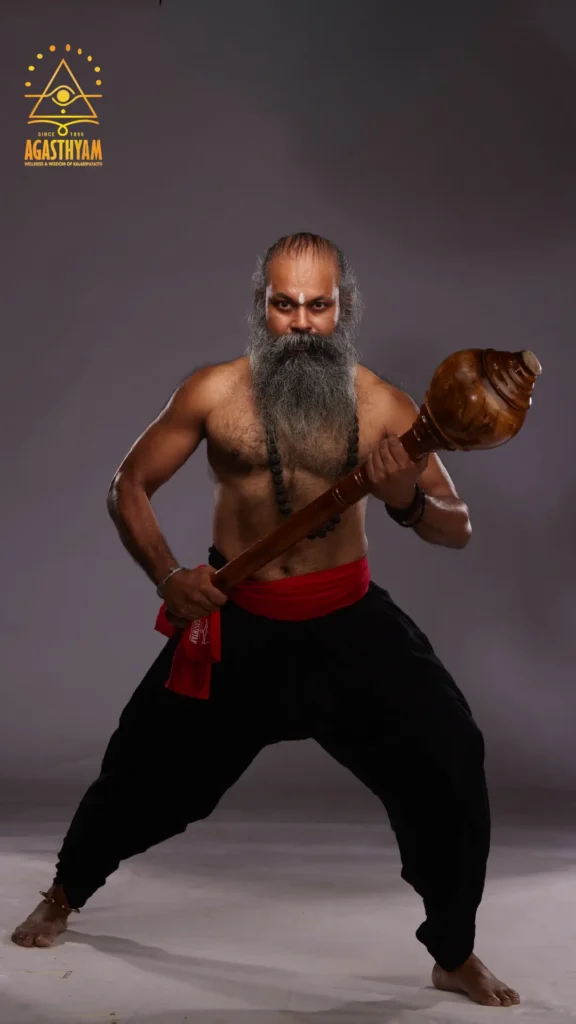
You can watch Kalaripayattu videos anywhere. Learn patterns online. Read books. Attend workshops.
So why board a plane?
Because information isn’t experience.
A screen can’t give you the atmosphere of a traditional Kalari. A video can’t teach the bond between Guru and student. You can’t know what it means to wake at 5:30 AM, train twice a day and live inside the rhythm of practice without doing it.
And you can’t fully understand Kerala’s martial tradition without encountering Kerala itself.
Come to Kerala. Enter the Kalari.
Agasthyam isn’t a sightseeing trip with a class added on. It isn’t a demonstration. It isn’t a fitness holiday.
It’s an invitation into a living Indian martial tradition. To train under a fifth-generation Gurukkal. To live in a traditional environment. To practise Kalaripayattu alongside yoga, meditation and traditional wellness.
To wake before sunrise. Train. Eat. Rest. Observe. Serve. Practise again.
And slowly, to understand why the Kalari remains the enduring symbol of Kerala’s martial heritage.
In Search of the Warrior Within
Maybe you train in another martial art. Maybe you practise yoga. Maybe you research Indian traditions. Maybe you want something beyond ordinary tourism.
Whatever brings you here, the Kalari asks one thing: are you willing to practise?
Go deeper and you’ll find Kalaripayattu isn’t only about fighting. It’s about preparation. Of the body. Of the breath. Of the mind. For life.
From across the world, come to Kerala. Enter the Kalari. Meet the Guru. Live the tradition. Discover Warrior Yoga.
Apply for residential Kalaripayattu training in Kerala → [link to programme / enquiry page]
Agasthyam Kalaripayattu Excellence Centre for Kalaripayattu and Indian Knowledge Systems Nemom, Thiruvananthapuram, Kerala, India Residential Kalaripayattu · Warrior Yoga · Traditional Wellness · Indian Knowledge Systems
FAQ
Where is the best place to learn Kalaripayattu in Kerala?
Kalaripayattu is best learned in Kerala, where it originated, under a traditional Gurukkal. Agasthyam Kalaripayattu in Nemom, Thiruvananthapuram offers residential training under fifth-generation Gurukkal S. Mahesh.
Can foreigners learn Kalaripayattu in India?
Yes. Agasthyam welcomes international students through its residential Kalaripayattu programme, with accommodation, meals and a structured daily routine included.
Do I need martial arts experience to train?
No. Training is progressive. Beginners start with body conditioning and foundational movements; experienced practitioners go deeper into traditional practice.
What is a typical day of residential Kalaripayattu training like?
The day starts at 5:30 AM with preparation, Sauranga, meditation and Kalari Sadhana, followed by study, an afternoon Kalari session, Seva and recovery in the evening.
What is Warrior Yoga?
Warrior Yoga is Agasthyam’s approach that brings together Kalaripayattu, yoga, breath, meditation and traditional wellness, exploring the link between martial practice and inner development.
Is it Kalaripayattu or Kalarippayattu?
Both spellings are used for the same martial art. Kalarippayattu is closer to the Malayalam pronunciation.