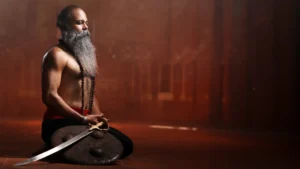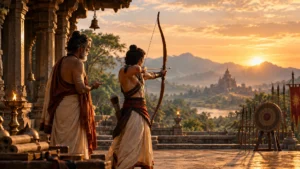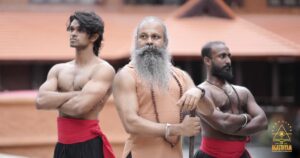
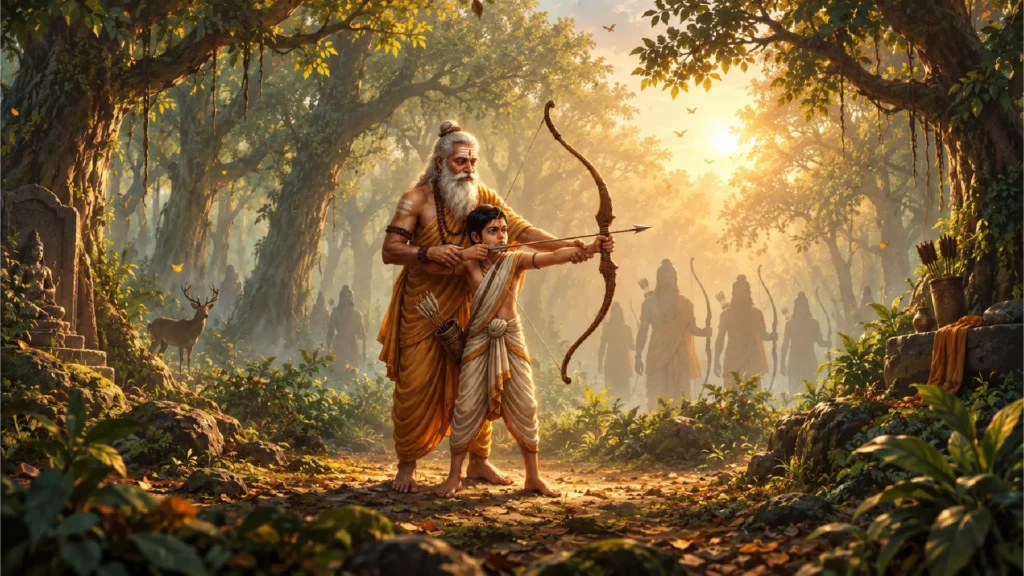
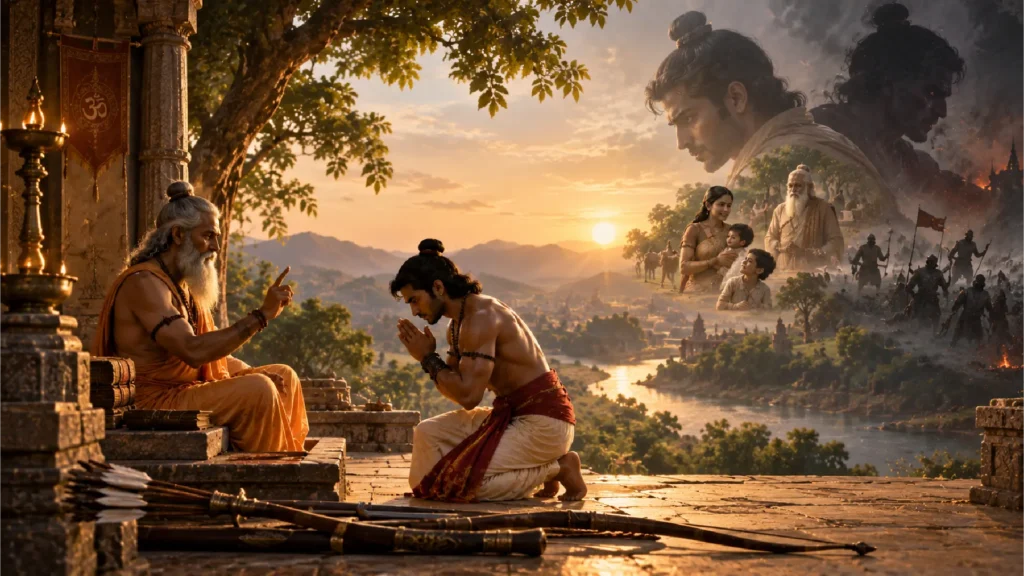
Imagine a young warrior standing before his teacher.
His bow is ready.
His body is trained.
His eyes are fixed on the target.
But before he is allowed to release the arrow, his teacher asks him a question:
“What are you protecting?”
The student hesitates.
The teacher does not ask about the target. He asks about dharma.
This is the difference between learning a weapon and learning the science of the warrior.
In the Indian knowledge tradition, the ideal warrior was never merely a man who knew how to fight. He was expected to understand society, ethics, strategy, the body, language, philosophy, ritual, medicine and the responsibilities of power. His weapon was only one part of his education. His real training was much larger.
This is where the ancient concept of the Aṣṭādaśa Vidyāsthānas, the eighteen fields of knowledge, opens an extraordinary window into the Indian civilisation of learning. And at the heart of this larger vision stands Dhanurveda.
The science of the bow. The science of weapons. The science of the warrior.
But ultimately, the science of responsible power.
Where the Tradition Begins
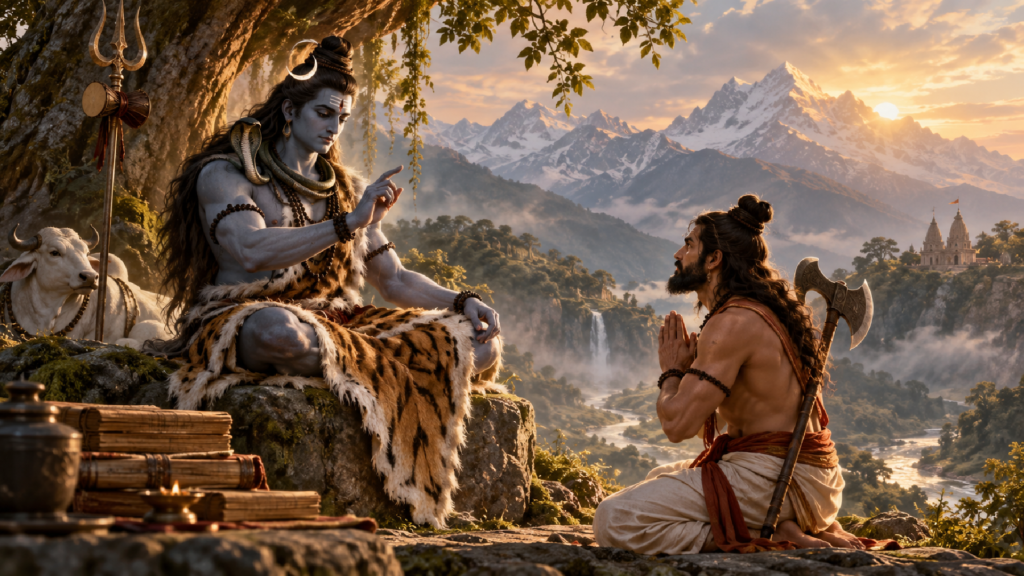
The Dhanurvedic tradition opens with Vasistha speaking to Viswamitra:
Athovāca Mahādevo Bhārgavāya ca dhīmate |
Tatrovāca sampravakṣyāmi yathā jñānena śṛṇu ||
“Thus, Mahādeva spoke to the wise Bhārgava. What was taught by Him, I shall now expound; listen with understanding.”
This takes us directly into the sacred relationship between Guru, Shishya and martial knowledge. In the traditional account, Mahadeva imparts the knowledge of Dhanurveda to Bhargava Parasurama, the great warrior-sage of the Bhrigu lineage. From this ancient stream, martial knowledge is remembered as passing through generations of rishis, teachers and warriors.
The Great Dhanurveda Paramparā
The story of Dhanurveda cannot be reduced to one text, one region, or one teacher. It is a much larger tradition, shaped over generations and preserved through the Guru–Shishya Paramparā.
At its highest traditional level stands Sadasiva, representing the divine source of martial knowledge. From this sacred foundation emerged different streams of teachers, rishis, warrior-sages and martial lineages that carried knowledge of weapons, warfare, discipline, strategy and the conduct of a warrior.
Parasurama and the Bhargava tradition. Among the most important is the Bhargava tradition, associated with the lineage of Bhrigu. At its centre stands Parasurama, remembered as a warrior-sage and great master of weapons. His tradition represents an important Indian ideal: the warrior must possess strength, but that strength must be guided by knowledge, discipline, tapas and dharma.
Vasistha and Viswamitra. The tradition of Vasistha also occupies an important place in the wider transmission of knowledge. His association with Viswamitra is particularly significant. Viswamitra began as a warrior-king and, through intense tapas and spiritual discipline, attained the status of a Brahmarshi.
Bharadwaja. Bharadwaja belongs to this broader intellectual and martial heritage. Like several of the great rishis, his traditional legacy extends across different fields of knowledge, reflecting a time when warfare, physical culture, medicine, science, philosophy and statecraft were not viewed as completely separate disciplines.
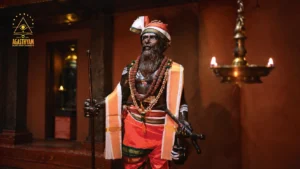
Agastya. Agastya occupies a particularly important place in the southern traditions. He is remembered as a great rishi and teacher associated with many branches of knowledge, including Kalari, medicine, the human body, weapons and martial discipline. Traditions connected with Agnivesha provide another important strand in the remembered transmission of martial knowledge.
Drona and Arjuna. This stream is traditionally associated with Drona, who became one of the great martial teachers of the Mahabharata. Drona trained the Kuru princes in the use of weapons and the various disciplines of warfare.
Among his students, Arjuna became the outstanding example of the disciplined archer. His achievement was not simply a matter of natural ability. It came through concentration, constant practice, dedication to the Guru and complete commitment to his chosen discipline. Arjuna became more than a great archer in the epic tradition. He became a model of what disciplined training could achieve.
Alongside these well-known figures, other teachers and rishis, including Kripa, Saradvan, Kashyapa, Parasara and Garga, appear in different textual and traditional contexts connected with knowledge of warfare, weapons, discipline and the preservation of ancient sciences.
It is important, however, not to place all these figures into one rigid historical timeline. The Dhanurvedic tradition comes to us through different sources: Itihasa, Puranic traditions, Niti literature, Shastric works and specialised martial texts, belonging to different periods and traditions.
It was the Shastra of the warrior, a disciplined body of knowledge encompassing weapons, archery, hand-to-hand combat, physical training, strategy, battlefield formations, chariot warfare, horses, elephants, ethics, discipline and the responsible application of force.
At its highest level, Dhanurveda was concerned with something deeper than victory.
It was concerned with the formation of the warrior.
The warrior had to master the body, sharpen the senses, steady the mind, understand the weapon, read the battlefield and, above all, remain governed by dharma.
The Sacred Foundation of Dhanurveda
Dhanurveda literally means the knowledge of the bow, from dhanuḥ, bow, and veda, knowledge. It is traditionally counted among the Upavedas and is particularly associated with the Yajurvedic tradition.
Yet the bow is only the doorway.
The complete Dhanurvedic discipline encompasses the warrior’s entire field of knowledge: how to stand, how to move, how to hold a weapon, how to aim, how to release, how to fight without a weapon, how to move with a horse or chariot, how to organise an army, how to read terrain, how to form battle arrays and how to conduct conflict according to principles of righteousness.
The tradition also remembers a succession of great seers and teachers connected with this knowledge: Sadasiva and Siva, Parasurama, Bhrigu, Vasistha, Viswamitra, Bharadwaja, Agastya, Agnivesha and other martial teachers appearing across epic, Puranic and Dhanurvedic traditions.
The importance of these names is not that they necessarily belonged to one single historical school or authored one surviving textbook together. Rather, they represent the larger civilisational memory of martial knowledge transmitted through guru-parampara.
The rishi was not separated from the warrior. Knowledge of the body, mind, weapon, healing, discipline and dharma existed within an interconnected vision of life.
The Four Padas of Dhanurveda
The traditional description presents Dhanurveda through four principal padas, or divisions.
- Dikshapadam: Initiation and Foundation
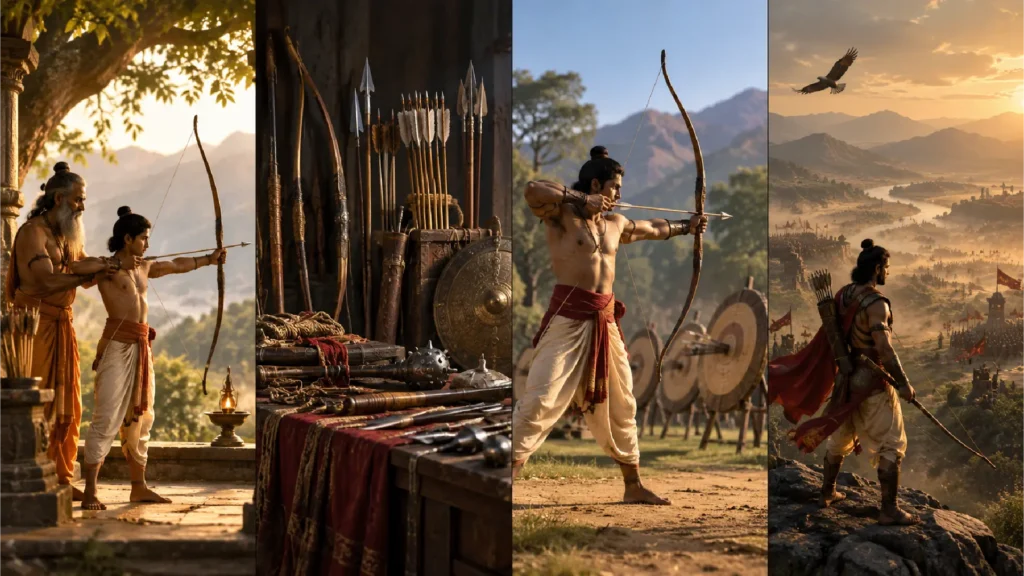
Diksha marks the entry of the student into the discipline. The foundations include stance, posture, grip, body alignment, aiming, drawing and release. The student learns how the feet connect with the ground, how the body is positioned, how the bow is held and how the mind is directed towards the target.
But initiation is not merely physical. The student enters a relationship with the Guru and accepts the discipline required to handle knowledge and power responsibly.
- Sangrahapadam: Collection and Preparation
Sangraha concerns the gathering, preparation and understanding of weapons. The warrior must know the nature, construction, characteristics, maintenance and appropriate application of different weapons.
A weapon is only as effective as the knowledge behind its use.
- Siddha Prayoga: Accomplished Application
Siddha Prayoga concerns mastery. The student develops proficiency in drawing, shooting, casting, handling and controlling weapons. Bow types, arrows, grips, methods of drawing and release, accuracy and repeated practice become increasingly refined.
The objective is not merely to perform a movement correctly once, but to make the action precise, controlled and dependable.
- Prayoga Vidhi: The Method of Application
Prayoga Vidhi is the practical science of application. A warrior must understand distance, wind, terrain, movement, timing, direction and circumstance.
The same weapon behaves differently according to the conditions in which it is used.
Thus, Dhanurveda moves from Initiation → Preparation → Mastery → Application.
The Inner Chapters of the Warrior's Science
The Dhanurvedic tradition contains a broad series of technical subjects concerning the bow and arrow:
- Dhanuḥ Lakshana examines the characteristics and qualities of the bow.
- Dhanur Grahana concerns the correct manner of holding it.
- Jya Bandhana concerns the stringing of the bow.
- Mushti concerns the grip.
- Shara Lakshana deals with the characteristics and qualities of arrows.
- Shara Sadhana concerns setting the arrow.
- Lakshya is the science of the target.
- Mokshana or Vimoksha concerns the release.
The warrior must establish the correct position, hold the weapon correctly, prepare the arrow, perceive the target, control the body and mind, and release at precisely the right moment.
The science therefore trains coordination between perception, posture, breath, concentration, weapon and intention.
The Ten Angas
Another important framework describes ten limbs of martial practice:
- Adhana: taking up the weapon
- Sandhana: preparing and setting the weapon
- Mokshana: release
- Vinivartana: withdrawal or reversal
- Sthana: stance and position
- Mushti: grip
- Prayoga: application
- Prayascitta: correction and expiation
- Mandala: movement and formation
- Rahasya: the deeper or secret principles of the science
The warrior had to know how to enter action, how to maintain control, how to withdraw, how to change position, how to correct an error and how to understand principles that could not be reduced to external technique alone.
Astra, Shastra and the Classification of Weapons
One of the most sophisticated features of Dhanurveda is its classification of weapons. Weapons are traditionally distinguished according to the manner in which they are held, released or propelled.
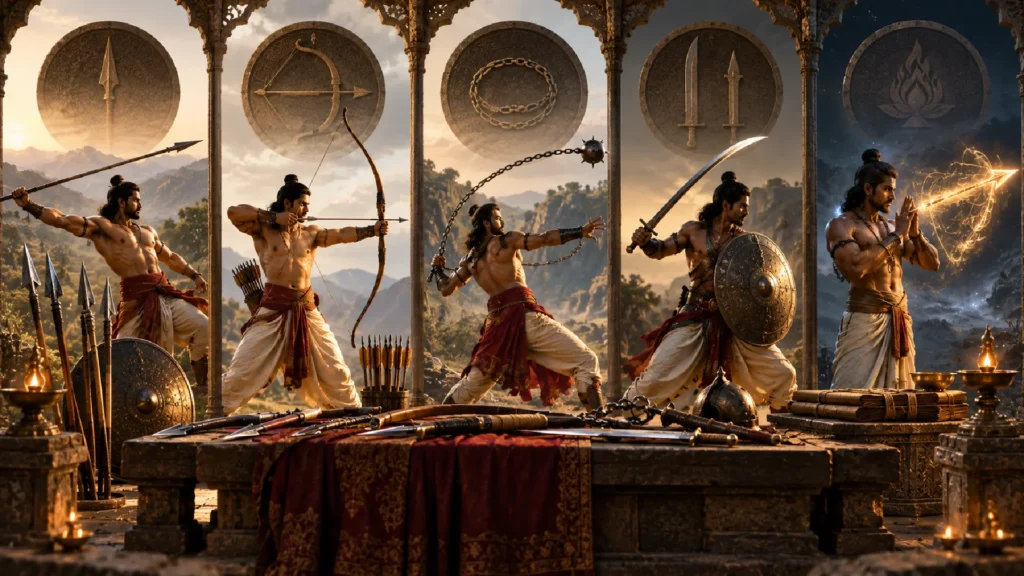
- Pani-mukta refers to weapons released directly from the hand, such as spear- or lance-like weapons.
- Yantra-mukta refers to mechanically propelled weapons, prominently including arrows released from bows.
- Mukta-mukta refers to weapons that can be released and subsequently recovered or returned.
- Amukta refers to weapons that remain in the warrior’s hand, such as swords and daggers.
- Mantra-mukta refers to specialised weapons associated with sacred invocation.
Dhanurvedic sources further distinguish Mukta, Amukta, Muktamukta and Mantramukta categories and describe weapons according to their method of deployment.
The Seven Forms of Combat
The Dhanurvedic tradition recognises multiple forms of combat:
- Dhanus: bow
- Chakra: discus and circular weapons
- Kunta: spear or lance
- Khadga: sword
- Kshurika: dagger or short blade
- Gada: mace
- Bahuyuddha: combat using the body
Mushti Yuddha: The Body as a Weapon
Mushti Yuddha represents the close-combat dimension of the martial tradition. Striking, grappling, physical control, balance, footwork, body positioning and close-range combat all require the warrior to understand the body as an instrument of combat.
This creates an important principle: the weapon extends the warrior; it does not replace the warrior. The trained body must remain capable even when the weapon is lost, broken or unavailable.
Ratha, Ashva and Gaja Vidya
Dhanurveda extends beyond the individual fighter into the larger architecture of warfare.
Ratha Vidya concerns the chariot and the warrior’s relationship with the charioteer and vehicle.
Ashva Vidya concerns the horse and mounted movement.
Gaja Vidya concerns the elephant and its use in warfare.
The battlefield therefore becomes an integrated system of warrior, weapon, animal, vehicle, movement and terrain. A skilled warrior must know how to operate from different positions and how movement affects the use of weapons.
Chariot warfare demanded coordination between the warrior and charioteer. Mounted combat demanded balance, timing and control. Elephant warfare demanded an understanding of a vastly different battlefield platform. The warrior’s education was therefore considerably larger than personal combat.
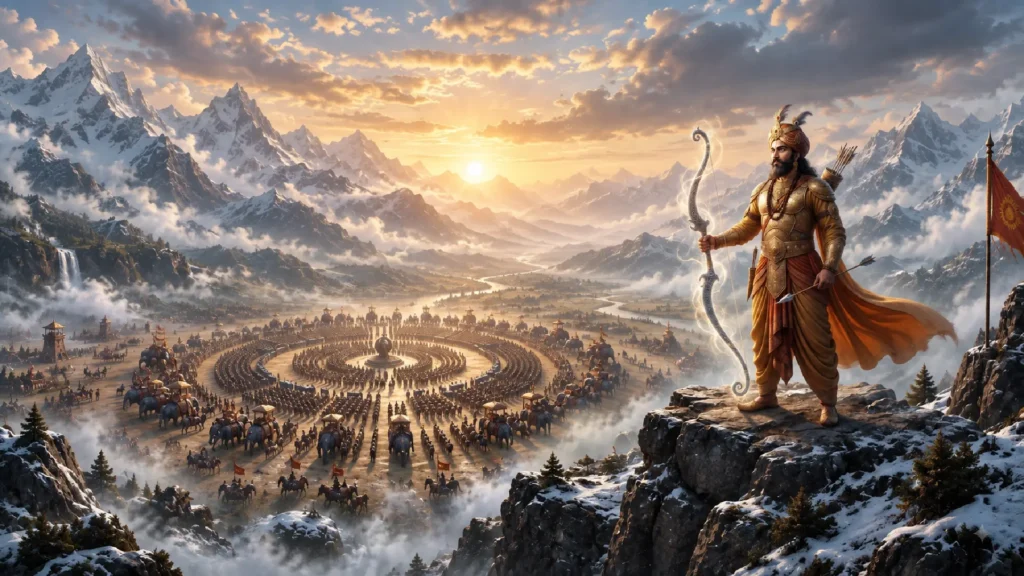
Vyuha: The Architecture of Battle
The science of Vyuha represents the strategic dimension of Dhanurveda. Ancient Indian military traditions describe formations such as:
- Syena: the falcon formation
- Krauncha: the heron formation
- Shakata: the cart formation
- Simha: the lion formation
- Padma: the lotus formation
- Sarpa: the serpent formation
- Agni: the fire formation
A Vyuha was a living strategic structure. It determined where warriors stood, how forces moved, where strength was concentrated and how an enemy could be penetrated, surrounded or resisted.
The battlefield was treated almost like a moving mandala. Every warrior had a position. Every movement had a purpose. Every formation carried strategic intent.
The Ethics of the Warrior
Dhanurveda also recognised that martial power without discipline could become destructive.
The purpose of the warrior was not violence for its own sake. The warrior’s responsibility was connected with protection: of the righteous, the vulnerable, the sages, the community and the social order. This is why martial education required more than physical strength. The student needed discipline, loyalty, courage, restraint, obedience to the Guru and knowledge of dharma.
The greatest warrior was not the one who possessed the greatest anger. It was the one who possessed the greatest control over that anger.
The bow could be drawn by physical strength. But only discipline could decide when to release it.
The Hierarchy of Martial Mastery
Dhanurvedic tradition even describes different levels of accomplishment:
Ācāryaḥ saptāyudhasya, caturbhiḥ Bhārgavaḥ smṛtaḥ |
Dvābhyāṃ caiva bhaved yoddhā, ekena gaṇako bhavet ||
- The Acharya represents the highest mastery, possessing knowledge of seven forms of combat.
- The Bhargava is associated with mastery of four.
- The Yoddha possesses mastery of two.
- The Ganaka possesses mastery of one.
A master is defined by the depth of knowledge, breadth of mastery and ability to transmit that knowledge to others.
The Warrior Within the Weapon
At its deepest level, Dhanurveda is a science of alignment.
The bow must be aligned.
The arrow must be aligned.
The body must be aligned.
The breath must be aligned.
The mind must be aligned.
And finally, the warrior’s action must be aligned with dharma.
The external target may be an enemy, a mark or a battlefield objective. But the internal target is the warrior’s own weakness: fear, anger, hesitation, arrogance and lack of discipline.
That is why the ancient warrior tradition placed such importance upon the Guru.
The Guru did not merely teach the student how to fight. He taught the student when not to fight.
He did not merely teach the use of weapons. He taught the responsibility that comes with possessing them.
He did not merely create warriors. He created custodians of knowledge.
From Dhanurveda to the Southern Martial Traditions
Dhanurveda was not simply about shooting arrows.
The wider Indian martial tradition included knowledge of weapons, movement, physical conditioning, concentration, strategy and the human body. In the southern traditions, this understanding developed through many different lineages.
In Kerala, we have Kalarippayattu.
In Tamil traditions, we find Silambam, Adimurai and Varma Kalai.
These traditions have their own histories, teachers and regional development. We should respect those differences.
At the same time, there are deep similarities in their understanding of the warrior. The warrior must develop the body. He must develop speed. He must develop flexibility. He must understand weapons. He must understand the vital points of the body.
And above all, he must develop discipline.
This is where Marma and Varma knowledge become important.
The Knowledge of Marma
One of the most fascinating aspects of our traditional martial knowledge is the understanding of the vital points of the human body. In Kerala we speak about Marma. In the Tamil traditions, we have the profound knowledge of Varma Kalai.
A warrior who understands the body knows that certain areas are vulnerable. But the Gurukkal must understand something more important.
He must also know how to protect the body. He must know how to treat injury. He must know how to restore the body.
This is why traditional martial knowledge was closely connected with healing. The same knowledge that could make a warrior effective in battle could also help the teacher understand injury and recovery.
For me, this is one of the most beautiful aspects of the old Gurukkal tradition. The warrior and the healer were not completely separate. Knowledge of the body could be used for protection, for martial training and for healing.
That is why I do not see Kalari merely as a fighting system.
It is a complete discipline of the human being.
Was Agastya the Father of Kalarippayattu?
People sometimes ask me: “Gurukkal, was Agastya the father of Kalarippayattu?”
I understand why this question comes up. Agastya has such a powerful place in the southern traditions, particularly in connection with Varma, medicine, yoga and ancient knowledge.
But I would answer carefully.
Kalarippayattu evolved through generations of Gurus, warriors, healers and communities. Different regions developed different methods. Different lineages preserved different knowledge.
But I would certainly say that Agastya stands among the great ancestral figures of the southern martial knowledge tradition. He represents an ancient vision in which the warrior, healer, yogi and seeker of knowledge were not completely separate identities.
That vision is important.
The Warrior and the Healer
In our modern world, we often separate everything. We have one person for physical training. Another for medicine. Another for psychology. Another for spirituality. Another for self-defence.
But the traditional Gurukkal had a much more integrated understanding. The body was one system. The breath was connected with the body. The mind affects the body. The weapon demanded control. And knowledge demanded responsibility.
That is why the student who enters a Kalari is not simply learning how to strike.
He is learning how to stand.
How to move.
How to breathe.
How to fall.
How to rise.
How to control fear.
How to control anger.
How to respect the teacher.
How to respect the weapon.
And finally, how to control himself.
This is the real meaning of martial training.
What Agastya Means to Me Today
For me, Agastya is not simply a character from an ancient story. He represents a way of thinking. A way of learning. A way of transmitting knowledge.
When I see a young student entering the Kalari today, I think about the enormous journey behind that simple movement.
From the ancient rishis.
From Dhanurveda.
From the warrior traditions of Bharat.
From the guru parampara.
From the knowledge of Marma and Varma.
From the southern traditions of Adimurai and Silambam.
From the generations of Gurukkals who preserved these arts.
And finally, into our generation.
We have received something precious. Our responsibility is not simply to say that our ancestors were great. Our responsibility is to become worthy of what they left behind.
We must practise.
We must research.
We must preserve.
We must teach.
And we must take this knowledge to the next generation without losing its soul.
For me, the greatest lesson from Agastya is not about how to defeat an enemy. It is about how to master oneself.
A warrior must have strength. But strength without discipline is dangerous.
A warrior must have courage. But courage without wisdom becomes arrogance.
A warrior must know how to fight. But he must also know how to protect.
And if he has the knowledge to injure, he must have an even greater responsibility to heal.
This is the warrior tradition I understand. This is the tradition I have received through my Gurukkal parampara. And this is the tradition I want to carry forward.
The Chain Must Not End With Us
Agastya gave knowledge to generations. Agnivesha received it. Drona carried it forward. Arjuna became one of its greatest practitioners.
And today, the responsibility of preserving India’s warrior knowledge has come into our hands.
Agastya → Agnivesha → Drona → Arjuna → the Gurukkal parampara → the next generation.
That is not merely a list of names. It is a responsibility. It is a living tradition. And it is our duty to keep that tradition alive.
The true warrior is not the one who knows only how to destroy. The true warrior is the one who has the strength to protect, the wisdom to heal and the discipline to control his own power.
This, to me, is the warrior spirit of Bharat.
Gurukkal S. Mahesh
Fifth Generation Kalari Gurukkal
Agasthyam Kalari